

AI will not take your job. Someone who knows how to use AI might.
Software development is changing faster than most careers can keep up. The question is no longer whether to use AI. It is whether you can use it well enough to become more valuable.
For years, the path into software development felt predictable.
Learn a language. Learn a framework. Complete a course. Build a few projects. Start applying for jobs.
That path was already competitive. Now AI is rewriting it while many aspiring developers are still preparing for the old version of the job.
AI coding agents can produce APIs, database logic, interfaces, tests and documentation at extraordinary speed. Employers no longer need a developer only because that person can type every line from scratch. They need someone who can decide what should be built, direct AI towards the right result, recognise when the result is weak and take responsibility for what finally ships.
The risk is not that software careers disappear overnight. It is that your skills stand still while the job moves on.
Everyone is using AI. Almost nobody fully trusts it.
The adoption question has already been answered. Stack Overflow’s 2025 Developer Survey found that 84% of respondents use or plan to use AI tools in their development process, but only 3.1% said they highly trust the accuracy of AI output, and more developers actively distrust it (46%)
That gap tells us what the new job really is.
AI creates speed. Human judgement turns that speed into value. A developer still needs to understand the problem. Someone still has to notice the edge case, question the architecture, reject the plausible-looking mistake, test what happens outside the happy path and decide whether the work is ready.
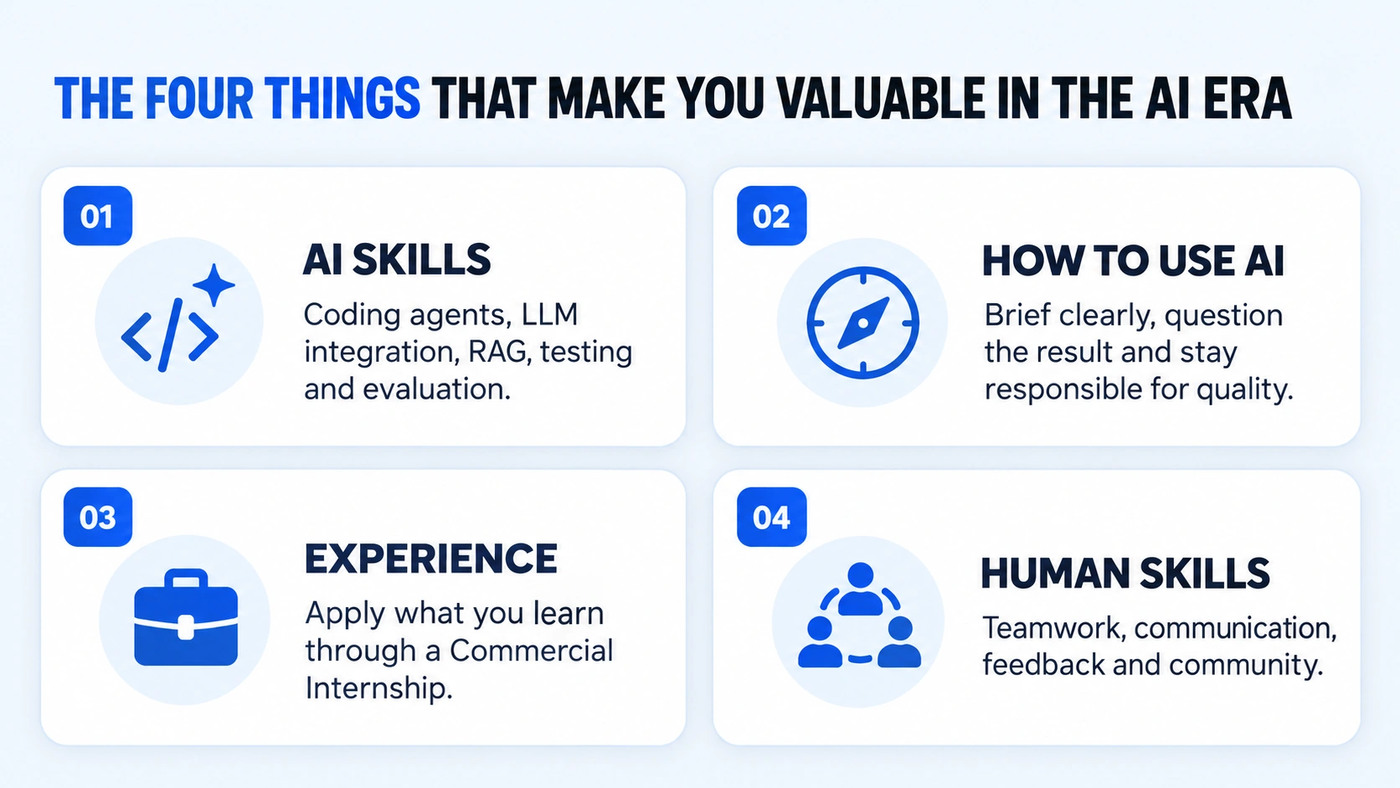
The four things that make Software Developer valuable in the AI era
Technology changes quickly. A durable career needs more than familiarity with today’s tools. It needs the ability to use those tools, apply them in a working environment and create results with other people.
We interviewed the industry experts in our Employer Network, the people who hire developers and manage teams, what makes Software Developer valuable now. 4 things came up again and again
- AI skills. Coding agents, LLM integration, retrieval-augmented generation, testing and evaluation.
- How to use AI. Brief clearly, question the result and stay responsible for the quality of what ships.
- Experience. Apply what you learn in a working environment through a Commercial Internship.
- Human skills. Teamwork, communication, responding to feedback and contributing to a team.
How traditional developer prepare in the AI-era
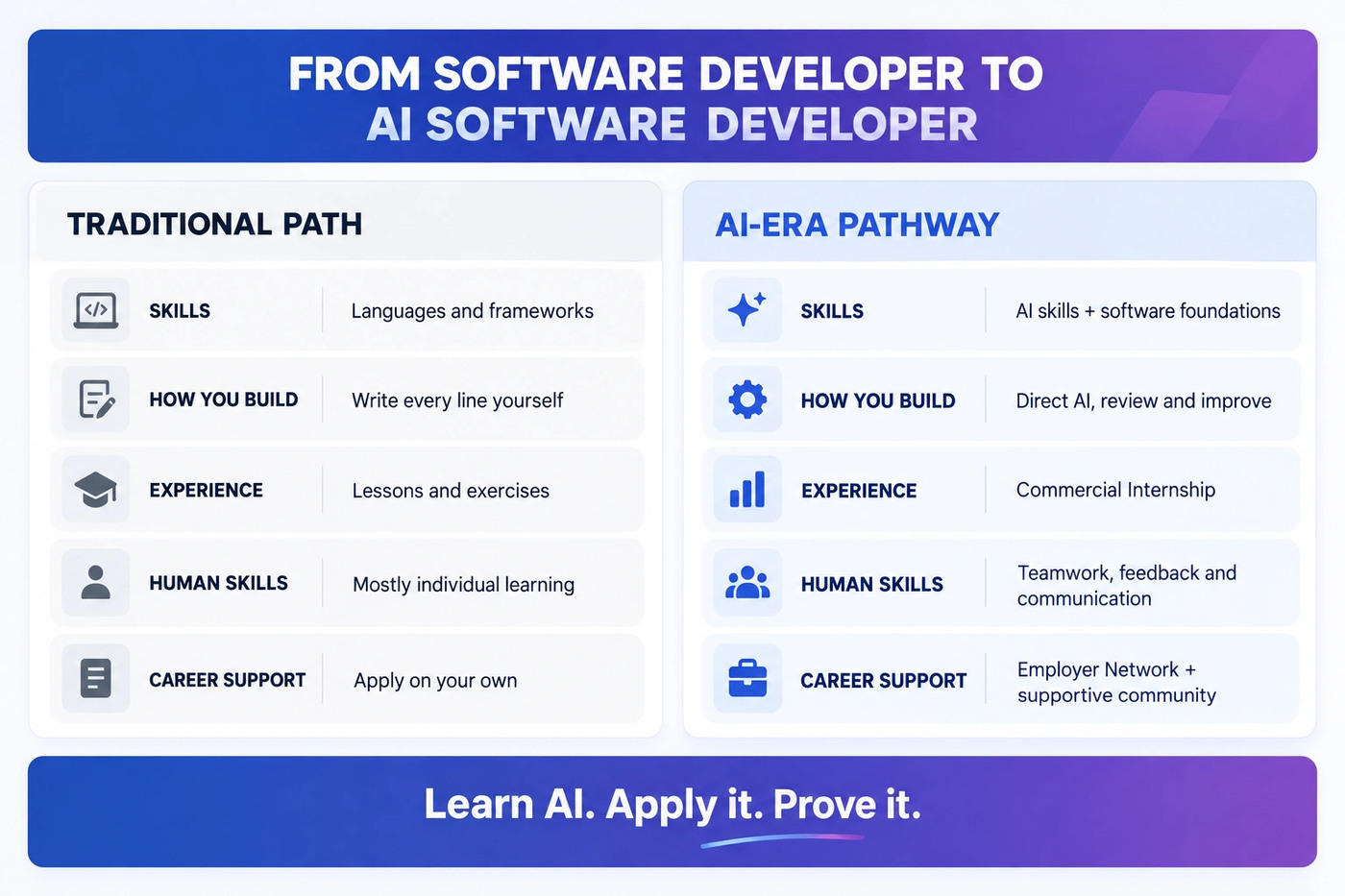
The fundamentals still matter. What changes is what comes around them.
| Traditional path | AI-era pathway | |
|---|---|---|
| Skills | Languages and frameworks | AI skills plus software foundations |
| How you build | Write every line yourself | Direct AI, review and improve |
| Experience | Lessons and exercises | Commercial Internship |
| Human skills | Mostly individual learning | Teamwork, feedback and communication |
| Career support | Apply on your own | Employer Network and a supportive community |
Imagine walking into your next interview with a different story
Imagine being asked how you use AI in software development and not having to answer with theory.
You can explain how you turn an ambiguous requirement into a clear engineering brief for an AI coding agent.
You can describe a generated solution that looked correct at first, the flaw you found, why you rejected it and how you improved the result.
You can discuss LLM integration, structured output and retrieval-augmented generation without treating the model like a magic black box.
You can talk about testing, evaluation, failure cases and the difference between a convincing demo and software prepared for real use.
Most importantly, you can point to commercial practice. Not only what you learned, but how you worked with other members, responded to feedback and contributed to production-ready project work.
You are not asking an employer to imagine your potential.
You are giving them evidence of how you learn, use AI, work with people, adapt and contribute.
Six months from now, AI will not be less important
Waiting can feel safe because nothing changes today.
But every new tool raises the baseline. Every employer that adopts AI changes what useful contribution looks like. Every candidate who learns to combine software judgement with AI leverage becomes harder to ignore.
You do not need to predict exactly what software development will look like in five years. You need to become the kind of developer who can adapt as it changes.
It’s the reason Industry Connect introduced AI Software Developer programme, which is completely new and industry-standard for new AI-era Software developer
Industry Connect built a pathway. It’s not just a training course
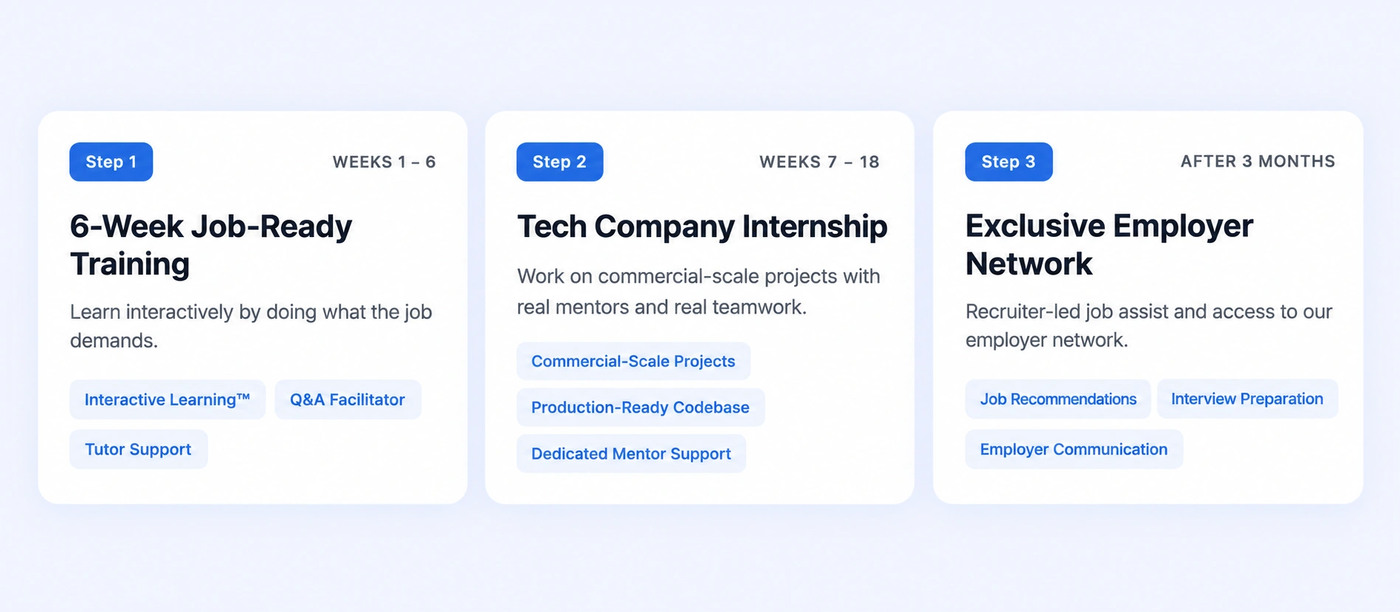
Six weeks of technical training can give you current knowledge. But training alone is not the finish line.
The hardest part of entering the industry is often the gap between knowing something and having used it in a working context. Employers want commercial experience. Candidates need an opportunity to create that evidence.
Train with current AI development capabilities
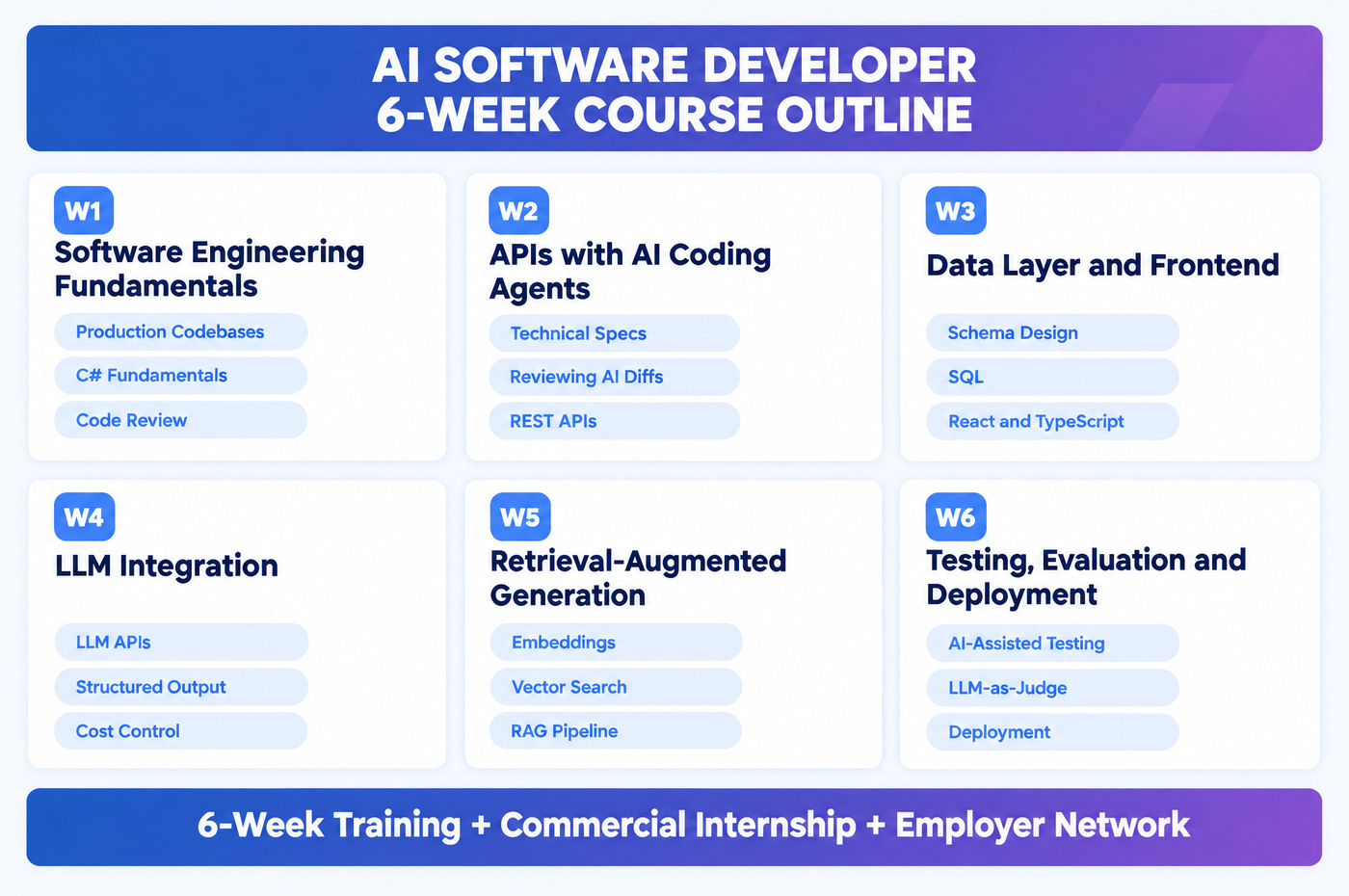
Over six weeks, develop the capabilities that increasingly shape modern software work: software engineering judgement, AI coding agents, LLM integration, retrieval-augmented generation, and testing and evaluation for AI-enabled systems.
This is not training in how to copy code from a chatbot. It is learning how to use AI for leverage without handing over your judgement.
Apply the skills through a Commercial Internship
After training, move into a Commercial Internship and practise contributing to production-ready project work.
This is where knowledge meets ambiguity, feedback, collaboration and delivery. You have the opportunity to work with other members, communicate your reasoning, respond when something does not work and improve the result together.
That experience gives you a richer story to take into the employment market because you have begun doing the work, not only studying it.
Connect through the Employer Network
Finding the right opportunity should not depend entirely on searching alone.
Industry Connect provides access to its Employer Network, Job Portal and career mentorship, helping participants connect their developing capability and commercial practice with employment opportunities in the market.
You also become part of a supportive community. You can learn alongside people facing the same career transition, exchange ideas, receive encouragement and keep building the confidence to present your value as the role changes.
Get the Info Pack and talk to our team
Five quick questions. We send you the Info Pack and an invitation to an advice session with our career team.
Recent Posts