
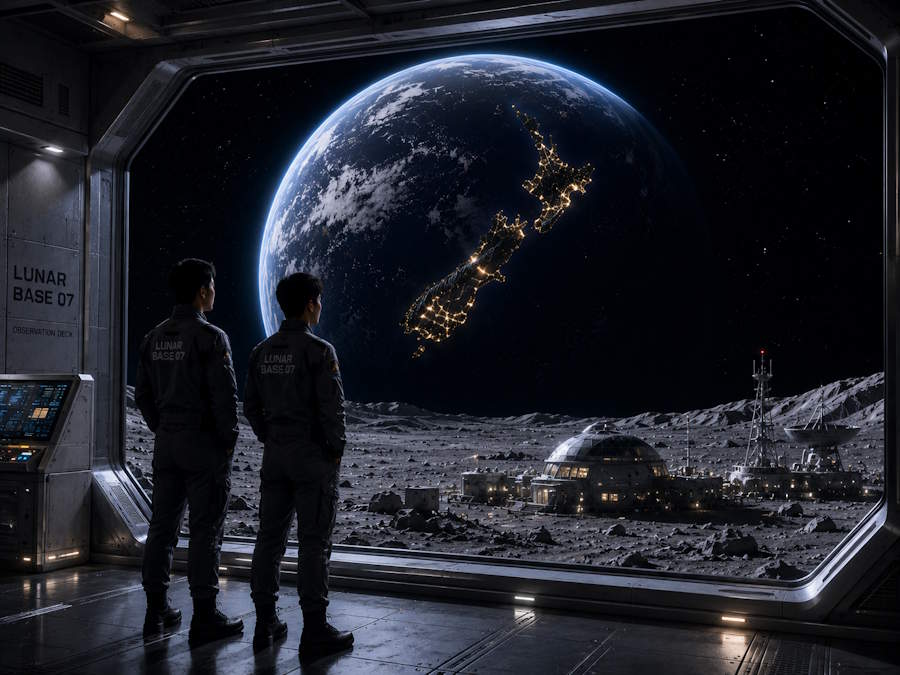
SpaceX, the Space Economy, and the Future of Tech Careers
The New Space Race Has Already Started
For most of human history, space was the domain of governments, scientists, and astronauts.
Today, a new era is unfolding.
Private companies are building rockets, launching satellites, creating global internet networks, developing AI infrastructure in orbit, and laying the foundations for a multi trillion dollar space economy.
At the center of this transformation stands Elon Musk and his company SpaceX.
What many people do not realize is that SpaceX is not just a rocket company.
It may become one of the most important infrastructure companies of the 21st century.
How SpaceX Changed Everything
Before SpaceX, launching something into space was incredibly expensive.
A rocket was used once and then discarded into the ocean.
SpaceX challenged that assumption.
By successfully landing and reusing rockets such as the Falcon 9, launch costs fell dramatically.
This breakthrough created a chain reaction:
- More satellites could be launched
- More startups could enter the industry
- More countries gained access to space
- New business models became possible
The next step is the massive Starship system, designed to carry unprecedented amounts of cargo into orbit and eventually transport humans to the Moon and Mars.
If successful, Starship could reduce the cost of space access by another order of magnitude.
The Rise of the Space Economy
The space economy is much bigger than rockets.
Think of space as a new layer of global infrastructure.
Satellite Internet
Starlink already provides broadband internet to remote regions around the world.
In the future, connectivity may become available almost anywhere on Earth.
Earth Observation
Thousands of satellites continuously monitor:
- Agriculture
- Weather systems
- Climate patterns
- Shipping routes
- Natural disasters
- Military activities
Governments and corporations increasingly rely on space based data.
Navigation and Logistics
Modern society depends heavily on satellite positioning systems.
Everything from ride sharing to aviation relies on space infrastructure.
AI Infrastructure in Space
A future possibility is deploying AI computing infrastructure in orbit.
Large solar arrays can generate enormous amounts of energy, while space offers unique opportunities for communication and global coverage.
As AI and space technologies converge, entirely new industries may emerge.
The Industries That Will Benefit
The space economy will create opportunities far beyond aerospace.
Artificial Intelligence
AI systems will help:
- Manage satellite constellations
- Analyze Earth observation data
- Predict orbital traffic
- Optimize communications networks
Robotics
Future space operations will require autonomous robots for:
- Satellite servicing
- Lunar construction
- Mining operations
- Space station maintenance
Cybersecurity
Protecting orbital infrastructure will become increasingly important.
Space assets are becoming critical national and commercial infrastructure.
Software Engineering
Every spacecraft, satellite, and autonomous system requires software.
The demand for engineers who can work across AI, cloud computing, and aerospace systems will continue to grow.
Data Analytics
The volume of data generated by satellites is enormous.
Organizations need analysts capable of turning raw data into actionable insights.
The Future Tech Careers
Many students imagine that working in the space industry means becoming an astronaut.
In reality, astronauts represent only a tiny fraction of future opportunities.
The space economy will need:
| Career Path | Why It Matters |
|---|---|
| Software Engineer | Builds mission systems and autonomous platforms |
| Data Analyst | Interprets satellite and operational data |
| AI Engineer | Develops intelligent decision systems |
| Robotics Engineer | Creates autonomous machines |
| Cybersecurity Specialist | Protects critical infrastructure |
| Product Manager | Coordinates complex technology projects |
| UX Designer | Designs interfaces for advanced systems |
| Cloud Engineer | Powers large scale space data platforms |
| Systems Engineer | Integrates hardware and software ecosystems |
Many of these roles already exist today.
The difference is that they are increasingly being applied to space related challenges.
What Students Should Learn Today
Nobody knows exactly which companies will dominate the space economy in 20 years.
But some skills will remain highly valuable:
1. AI Literacy
Understanding how AI systems work will become a foundational skill across industries.
2. Data Skills
Data is becoming the language of decision making.
Learning analytics, statistics, and visualization provides a strong foundation.
3. Technical Communication
The ability to explain complex ideas clearly is often more valuable than technical knowledge alone.
4. Problem Solving
Employers increasingly value evidence of real world problem solving over academic credentials alone.
5. Adaptability
Technology evolves rapidly.
The ability to learn continuously may become the most important career skill.
Why This Matters for Young Professionals
The internet created companies like Google, Amazon, and Meta.
The AI revolution is creating another wave of opportunity.
The space economy could become the next.
Many of the most valuable careers of the next 20 years may not even exist today.
Students who combine:
- AI skills
- Data literacy
- Real project experience
- Strong communication
- Continuous learning
will be positioned to thrive regardless of which technologies ultimately win.
Final Thoughts
SpaceX is not just building rockets.
It is helping create the infrastructure for humanity’s next economic frontier.
The space economy represents a convergence of aerospace, AI, robotics, software, communications, and advanced manufacturing.
For the next generation, the question is no longer:
“Do I want to work in space?”
The more relevant question may be:
“How can I develop skills that will be valuable in a world increasingly connected to space?”
The future belongs to those who can learn, adapt, and contribute to the technologies that expand human capability.
And for many young professionals, that journey can start today. 🚀
Recent Posts