

Your first finance job is being rewritten by AI. Here’s how to get ahead.
When routine accounting work disappears, where will the next generation of finance professionals learn judgement? And how can you gain the experience needed to move beyond the junior role?
Every Financial Controller, Finance Manager and CFO started somewhere.
- Processing invoices.
- Matching payments.
- Reconciling accounts.
- Preparing reports.
- Finding mistakes.
Slowly, through that work, they learned how money actually moved through a business.
The work was repetitive. But it was also the training ground.
Now AI and automation are beginning to process invoices, suggest account codes, match transactions, prepare reconciliations and draft financial commentary.
The Junior Accountant or Finance Analyst role may not disappear completely. But much of the work that traditionally prepared someone for the next position is changing.
If AI performs the beginner-level tasks, how will beginners gain the experience and judgement required for higher-value finance work?
The junior finance career is not simply disappearing. It is being redesigned.
| The junior role was | The junior role is becoming |
|---|---|
| Process more transactions manually | Understand the full workflow and investigate the exceptions |
| Prepare every report from scratch | Question assumptions, verify evidence and interpret what changed |
| Enter and move financial data | Use data and AI tools while remaining accountable for the result |
| Learn quietly through repetition | Build judgement through realistic scenarios, mentorship and teamwork |
The traditional training ground is changing.
Junior Accountants and Finance Analysts still need accounting knowledge. But they will also need stronger data capability, greater confidence with AI and more practice explaining how they reached a decision.
What we saw in our own numbers
Industry Connect has been helping people step into their first tech roles since 2013, and more than 1,000 companies have now hired at least one of our participants. Our Employer Network keeps us close to what those companies are actually recruiting for, cohort after cohort.
That vantage point is why we noticed this shift early. It appeared in our own placement data before we went looking for it.
We did not begin by deciding to create another accounting programme.
We began by looking at where our Data Analyst participants were finding opportunities, as well as the backgrounds of the people choosing that pathway.
They moved into banks, insurers, fintech companies and finance teams. These organisations were looking for people who could combine business understanding with data capability.
That result gave Industry Connect more than an employment statistic. It gave us a clear view of where demand was forming.
So we went and asked the employers.
Through our experience in the market, our Employer Network and ongoing conversations with industry advisors, including senior finance professionals, we could see that finance employers were redefining what useful junior capability looked like, and asked what they were actually short of.
Finance teams could already buy cloud accounting software, reporting platforms and AI tools. What they could not find were people who could use them responsibly: people who question an AI-generated entry that sounds confident but is wrong, who spot an incorrect tax treatment or the wrong reporting period and trace it back to its source, and who can work across Excel, SQL and AI, then explain the result to a manager or client.

So we built AI Accounting & Finance to support the shift in the market
Those conversations shaped what we built: finance foundations first, then data capability, then responsible AI use, then commercial practice and employment preparation in one connected pathway rather than five separate courses.
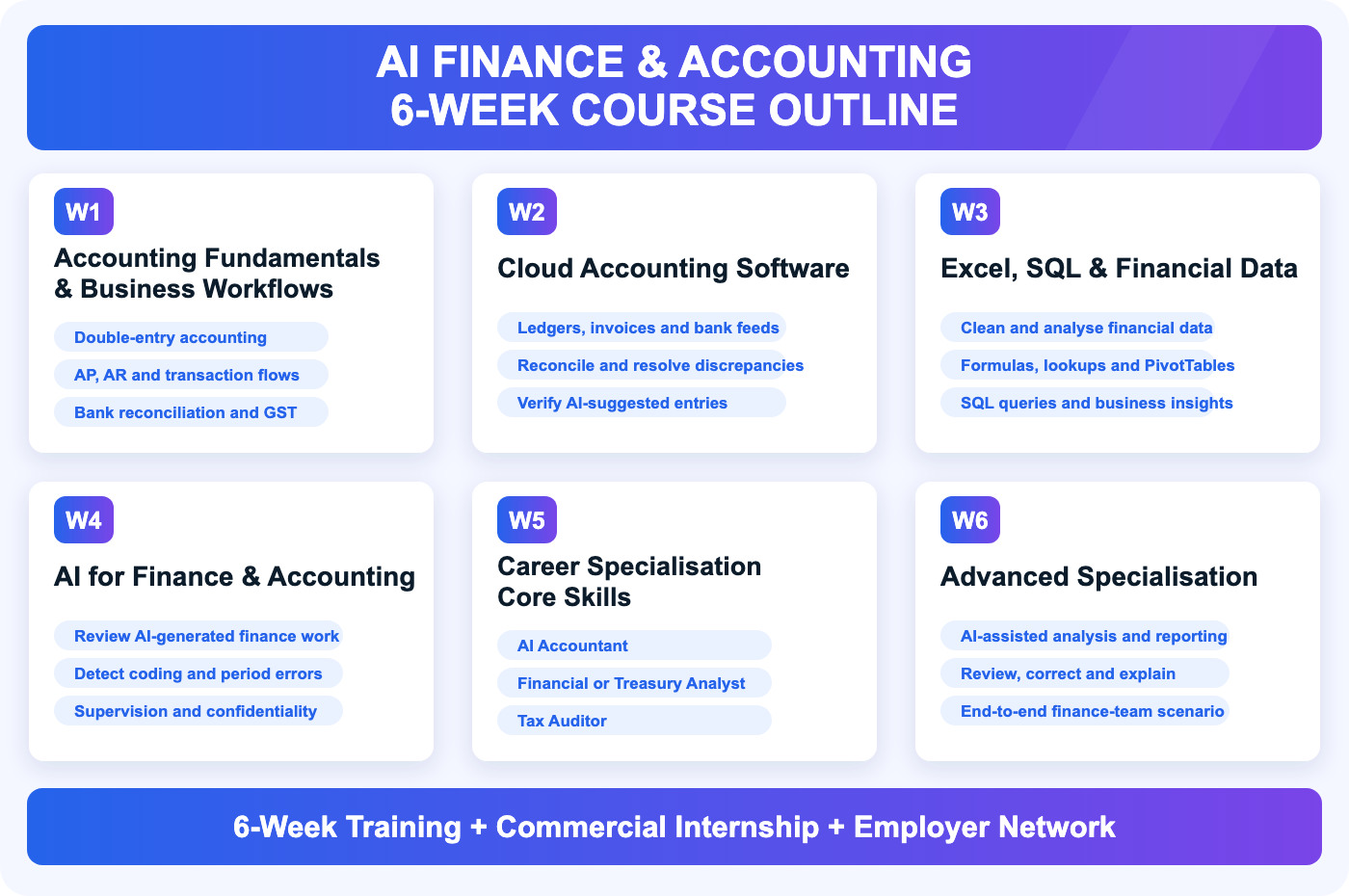
AI Finance & Accounting begins with the foundations: how accounting works, how transactions move through a business and how AP, AR, reconciliation and GST fit together.
Participants then work with cloud accounting software, Excel and SQL before learning how to review and correct AI-assisted finance work. They can develop deeper capability in multiple career paths: accounting, financial analysis, treasury or auditor.
Six weeks is the start, not the finish
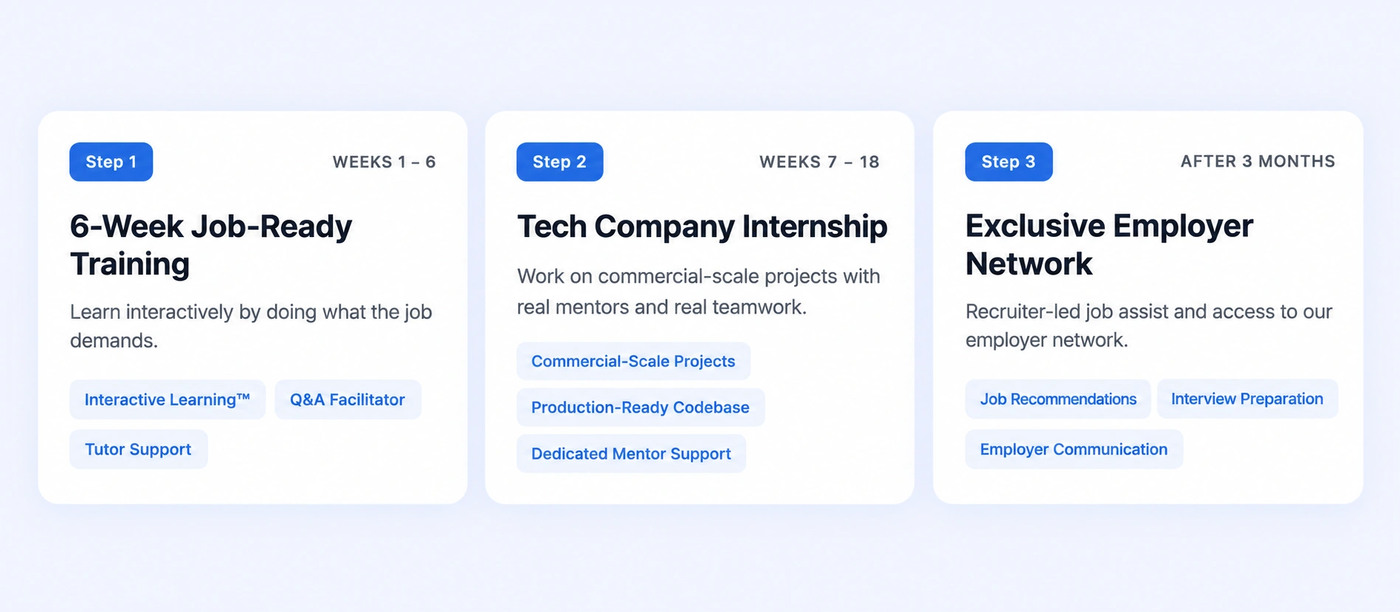
Six weeks of training to learn all important skills are just the start. In the first 6-week, you will build finance foundations and practise using cloud accounting, Excel, SQL and AI as parts of one connected workflow, then you will join 3 months+ Commercial Internship with our partners to work through commercial-style scenarios, unclear information, feedback and shared responsibility. Practise contributing rather than merely completing exercises. Then you will joining our Employer Network to access the Job Portal, career mentorship, CV and LinkedIn support, mock interviews, interview practice and a supportive community.
Get the Info Pack and talk to our team
Five quick questions. We send you the Info Pack and an invitation to an advice session with our career team.
Recent Posts