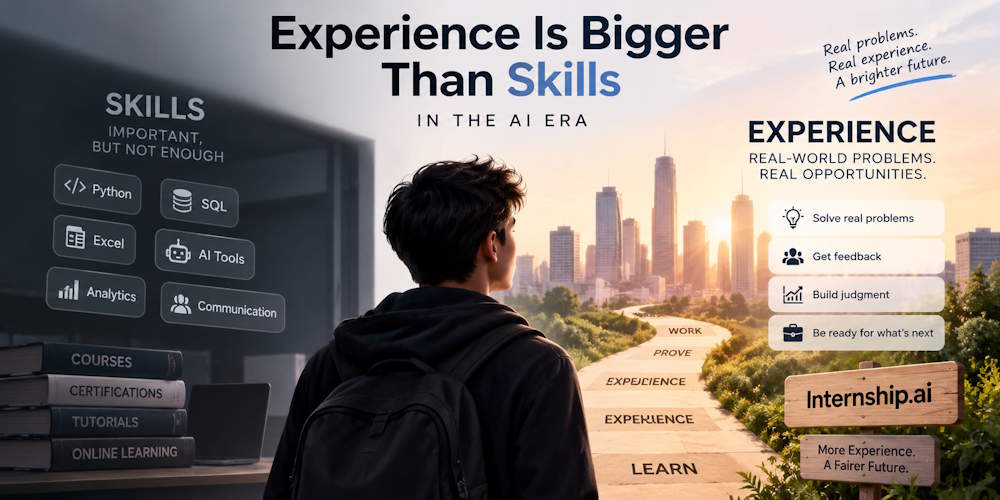
Experience Is Bigger Than Skills in the AI Era
For years, career preparation followed a simple formula:
Learn the skills → get the job → gain the experience.
AI may be turning that formula upside down.
A recent a16z Chart of the Week highlights an important shift in technology hiring. Based on data from Revelio Labs, since January 2025, tech job postings have shown a noticeable increase in preferred years of experience while the preferred number of skills has declined. The changes are relatively modest, around 5 to 10%, but the direction is significant.
The implication is worth paying attention to:
In the AI era, experience may be becoming more valuable than a predefined list of skills.
Why skills alone are becoming less valuable
Traditional hiring assumes that employers know what skills a job requires.
A software engineer needs Java.
A data analyst needs SQL.
A marketer needs analytics.
An accountant needs Excel.
But AI is changing jobs faster than we can define them.
The a16z article makes an important observation: when we are operating on a new technological frontier, employers themselves may not yet know exactly which skills will matter. What they do know is that they need people who can figure things out.
This is particularly visible in data and systems roles, which a16z notes are among the areas showing the strongest recent hiring premium for experience. As AI changes how data is collected, processed and used, yesterday’s technical checklist becomes less reliable.
The valuable worker therefore isn’t simply someone who knows more tools.
It is someone who knows what to do when the answer isn’t obvious.
Experience is more than time served
But there is a problem with the word “experience.”
Experience shouldn’t simply mean:
“You have worked for five years.”
Real experience is accumulated exposure to problems.
You receive an ambiguous task.
You decide where to start.
You use AI and other tools.
Something doesn’t work.
You investigate why.
You make a judgment call.
You communicate with other people.
You receive feedback.
You try again.
Eventually, you deliver something useful.
That cycle develops something much harder to teach than an isolated technical skill: professional judgment.
And this may become one of the most important human capabilities in the AI era.
The experience paradox
This creates a serious problem for the next generation.
Employers want experience.
But young people need employers to give them opportunities in order to gain experience.
We have created the classic career paradox:
You need experience to get a job, but you need a job to get experience.
If employers increasingly favor experienced workers, that gap could become even larger.
Education alone cannot completely solve it.
Students can learn Python, accounting, environmental science, cybersecurity or marketing. They can earn certificates and complete courses.
But knowing something and having used it in a real working context are fundamentally different things.
This is why I believe the future of career preparation must move beyond simply teaching more skills.
We need to scale experience.
From learning skills to experiencing work
Imagine if a university student could experience the work of a data analyst before applying for their first data job.
Instead of another course, they receive a realistic business problem.
They examine imperfect data.
They interact with an AI agent.
They make decisions.
They produce a deliverable.
They receive feedback.
They defend their reasoning.
They improve their work.
Now imagine doing this repeatedly across different companies, industries and roles.
That person may never have held the formal job title, but they are no longer approaching work for the first time.
They have begun accumulating career experience before employment.
This is why we are building Internship.ai
At Internship.ai, we are working on infrastructure for job simulation, virtual internships and internship management.
Our belief is simple:
If AI can scale intelligence, we should also use AI to scale access to experience.
AI can help companies turn real-world workflows, problems and professional knowledge into structured job simulations and virtual internships.
Instead of asking companies to create thousands of traditional internship positions, technology can help capture parts of the experience those positions provide and make them accessible to far more young people.
The goal isn’t to replace real internships.
It is to build a bridge toward them.
Learn → Simulate → Experience → Prove → Work
That could become a new career preparation pathway.
The opportunity gap may become an experience gap
AI is making knowledge extraordinarily accessible.
Anyone with an internet connection can increasingly access world-class explanations, coding assistance, research capabilities and creative tools.
So access to knowledge may no longer be the biggest differentiator.
Access to meaningful experience may be.
Who gets to work on real problems?
Who gets feedback from professionals?
Who learns how organizations actually operate?
Who has something credible to show an employer?
Historically, those opportunities have often depended on geography, university, family background, professional networks and luck.
AI gives us an opportunity to change that.
We can use technology not only to teach the next generation more skills, but to give millions of young people opportunities to experience work, demonstrate capability and build professional judgment before someone gives them their first job.
In the AI era, perhaps the question we ask young people should no longer be:
“What skills do you have?”
It should increasingly become:
“What have you experienced, what have you done, and what can you prove?”
That is a much more interesting future for education, internships and the future of work.
Reference
Moses Sternstein, “Chart of the Week: Experience > Skills,” a16z, September 4, 2026. The article discusses Revelio Labs data showing rising preferred experience and declining preferred skill counts in technology job postings since January 2025.
Recent Posts